New 2026 data, and the myths it overturns
Say "HPV" (human papillomavirus) and two assumptions still dominate. One ties it straight to "a chaotic sex life" and cervical cancer, and tips people into panic. The other is quiet optimism — "it won't happen to me."
In reality, both how common HPV infection is and how much risk it carries are backed by hard, recent numbers.
This article draws on research published between late 2025 and March 2026 by the Chinese Center for Disease Control and Prevention, the National Cancer Center, Nature's sister journals and JAMA Oncology, to lay out what HPV infection actually looks like.
1. The core numbers: the latest HPV infection rates
HPV does not discriminate by sex or by age. The newest figures put infection rates well above what most people assume, and men are infected noticeably more often than women — which is exactly what the "HPV is a women's problem" myth gets wrong.
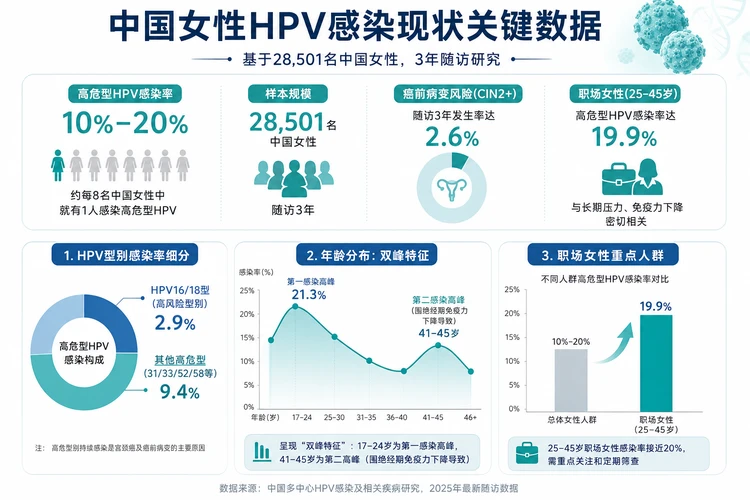
1.1 HPV infection among Chinese women (December 2025, large multicentre study)
According to a multicentre study by Qiao Youlin's team at the Chinese Academy of Medical Sciences, published in Nature Communications: about 12.5% — roughly one in every eight women — carry high-risk HPV.
1.2 HPV infection among men
- Global male HPV infection rate: 30–40%, far above the rate in women
- Male HPV infection rate in China: 39.6%, above the global average of 31%
- Worth adding: 75% of sexually active men pick up at least one HPV type within two years; among men who have sex with men, anal HPV infection reaches 73.5%
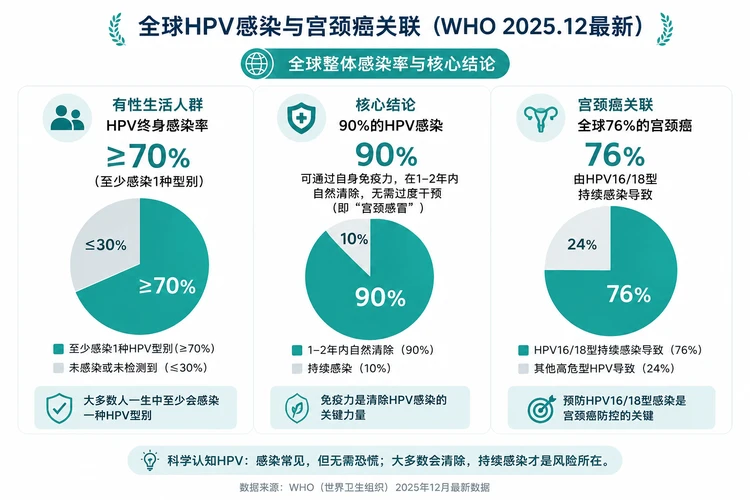
1.3 The global picture (WHO, December 2025)
WHO's latest data confirms HPV remains one of the most common sexually transmitted infections worldwide: about 80% of sexually active people will be infected with HPV at least once in their lifetime.
2. The follow-on: 2026 vaccine and screening policy
Alongside the infection data, vaccination and regular screening remain the two lines of defence against HPV and cervical cancer. The latest national policy has now been rolled out, lowering the barrier to protection further.
1. Free vaccination (nationwide in 2026): from 10 November 2025, girls born on or after 10 November 2011 are offered two free doses of bivalent HPV vaccine (covering HPV 16 and 18) once they turn 13. Rollout is happening region by region with different local timetables; there is no household-registration or urban–rural restriction.
2. New evidence on vaccine performance: a single dose of bivalent or nine-valent HPV vaccine gives at least 97% protection, non-inferior to two doses. Girls vaccinated at 9–14 years old produce antibody levels more than double those of people over 15, and protection lasts at least 10 years.
3. Cancer incidence data: in 2025 the annual growth rate of anal cancer in China reached 12%, and 90% of cases are linked to HPV 16/18. Oropharyngeal cancer has now overtaken cervical cancer as the leading HPV-related cancer, and in people who both smoke and drink, HPV 16 infection multiplies oropharyngeal cancer risk by 30 times.
3. What the data means: no panic, just protection
Put all the 2026 evidence together and the conclusion is not fear — it is attention. Three points stand out:
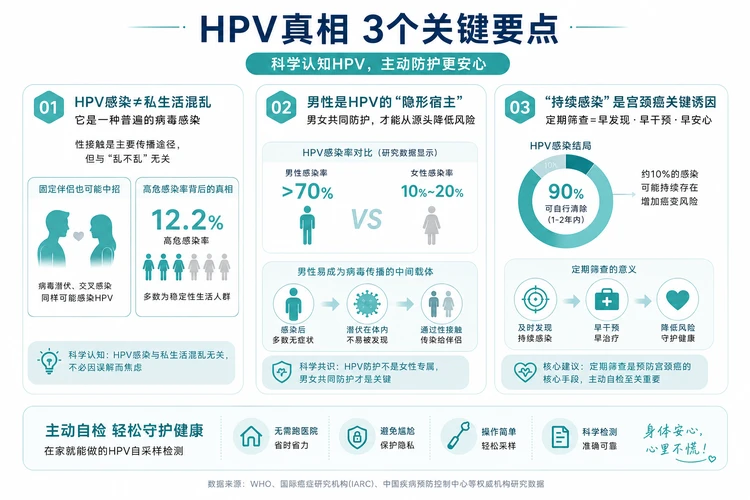
We publish these infection figures not to create anxiety but to replace myth with evidence, so that every woman can face HPV squarely and protect herself on purpose. You do not need to skip screening because it feels embarrassing, and you do not need to panic because the subject is unfamiliar. Take the initiative: get vaccinated on schedule, test yourself regularly, keep healthy daily habits — and keep cervical cancer at a distance.
References
- Nature Communications, December 2025 — Qiao Youlin team, Chinese Academy of Medical Sciences, "A multicentre epidemiological study of HPV infection among Chinese women"
- World Health Organization (WHO), December 2025, "Human papillomavirus and cervical cancer"
- National Health Commission and National Disease Control Administration, February 2026, "Progress on including HPV vaccine in the national immunisation programme" (Xinhua)
- New England Journal of Medicine (NEJM), February 2026, "Single-dose versus two-dose HPV vaccination: comparative protective efficacy"
- National Cancer Center, 2025, "Report on trends in HPV-related cancer incidence in China"
- "China HPV Infection Epidemiology Report", Duke Kunshan University, December 2025