Many people assume HPV can only be tested in a hospital. In fact, at-home self-sampling is an officially recognised screening method, already in use in more than 20 countries — and most women in China have never heard of it.
The UK recently launched a breakthrough public health programme: the National Health Service (NHS) began mailing free at-home self-sampling kits to roughly 5 million women in England who were overdue for cervical screening.
Women collect the sample themselves at home with a specially designed small brush, drop it into a street postbox, and it goes to the lab. A few days later the result arrives on their phone.
This is not an isolated case. Because of its clear advantages, self-sampling has been adopted by nearly 20 countries including the Netherlands, Australia and Sweden, and written into national cervical cancer screening guidelines.
In China the technique has likewise earned formal expert consensus, and pilots in several regions have confirmed its potential to raise screening coverage. The rollout is beginning.
Look at the global picture and it is a coordinated public health push:
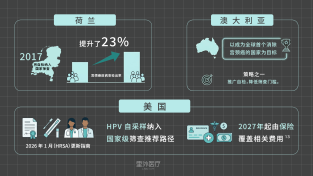
• Netherlands: self-sampling became part of the national programme in 2017, and detection of cervical pre-cancer rose 23% that year.
• Australia: with the goal of becoming the first country to eliminate cervical cancer, self-sampling is one of its core strategies.
• United States: the 2026 guideline update puts HPV self-sampling on the national recommended pathway, with insurance coverage planned from 2027.
Self-sampling has moved from frontier experiment to standard public health policy.
So why do so many women still not get screened?
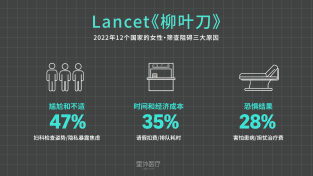
In 2022 The Lancet published a study surveying women in 12 countries, and found three real reasons.
First, embarrassment. 47% of women admitted that the position, the contact with a stranger, the exposure in the examination room — that is the hurdle they cannot get past.
Second, cost. 35% did the maths: unpaid leave, a taxi there and back, two hours in the queue, five minutes with the doctor — the time alone puts half of them off.
Third, fear. 28% said they were afraid of what a test might find and would not know how to face it.
Put those three together and you have the real reason screening coverage stays low.
It is not that women don't care about their health. It is that conventional care puts a wall in front of them.
At this point you may ask — is self-sampling actually accurate? Why would it be?
Here is the key logic:
Whether a clinician takes the sample or you take it yourself, the target is the same thing: cells shed from the cervix. Those cells come away naturally and carry HPV viral DNA, which is enough for a PCR test to read. The sampling method changed; the testing technology did not.
What do the numbers say?
In 2021 the Journal of Clinical Oncology published a meta-analysis covering more than 50,000 women. It concluded that PCR-based HPV self-sampling detects high-grade cervical lesions with 96% sensitivity, against 97% for clinician sampling.
A one-point difference. Essentially no statistical gap.
Three caveats that need saying.
First, self-sampling is a screening tool, not a diagnostic one. A positive self-test does not mean you have cervical cancer, but you do need a clinician to assess it further — colposcopy, TCT or biopsy to establish how far any lesion has gone. A negative self-test means retesting every three to five years, on the interval your doctor advises.
Second, even with the nine-valent vaccine, keep screening. The nine-valent vaccine covers the HPV types behind 90% of cervical cancers, but 10% are not in it. Vaccination prevents; screening detects. Neither replaces the other.
Third, and most important — going from HPV infection to cervical cancer takes on average 10 to 15 years. That is a very long window, which means anything found at any screening can still be acted on in good time.
Hospital or home, the method is not the point.
The point is that after reading this, you move "get an HPV test" off the "someday" list and onto the "this week" list.
Technology is making health checks more equal and more reachable.
All you have to do is one thing: start.
There are no shortcuts to health, but it can be simpler. One small step today is a big step for the years ahead.